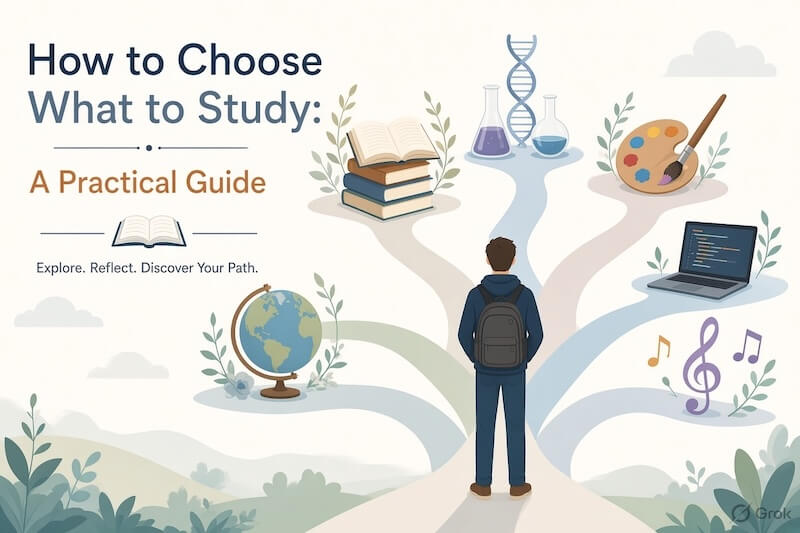
Choosing what to study can be surprisingly difficult. My wife always tells me she didn’t know what to study after high school, so she got a job. Who can blame her? At age 16, who knows what we want to do for 40 hours a week for the rest of our working lives!
For me, I had a home computer for my 12th birthday, and that sparked a career-long obsession with IT.
Everyone finds their own path in life, but some direction can be helpful.
Thousands of courses, degrees, certifications, and training programs are available online and offline. Then there are careers to think about, costs to consider, and the nagging question:
“What if I choose the wrong thing?”
You don’t necessarily need to know exactly what you want to do for the next 30 years.
A better approach is to work out what interests you, what opportunities are available, and what type of study makes sense for where you want to go.
Looking back on my school years, I realize the subjects I took weren’t the ones I was best at. In hindsight, If I had taken the ones I was better at, it might have led to more opportunities.
Schollara will help you get on the right path for your career.
1. Start with the career, not the course
One of the easiest mistakes to make is starting with a course.
You see an interesting degree or an online course and think, That looks good.
Instead, start with the destination.
Ask yourself:
- What sort of work would I like to do?
- What industries interest me?
- Would I prefer working with people, technology, numbers, ideas, or practical things?
- Do I want to work in an office, remotely, outdoors or somewhere else?
- How important is income to me?
- Do I want a career with lots of opportunities to progress?
- Would I prefer to work for an organisation or eventually work for myself?
You don’t need perfect answers.
You’re simply trying to narrow the field.
When I tell people what I do for a living (Information Technology), some of them say “Oh I could never sit in an office all day” Maybe that’s you. If so that would rule out a whole swath of career paths.
For example, someone interested in technology like me, they might discover that they don’t necessarily want to become a software developer. They might be more interested in cloud computing, cybersecurity, data, IT management, or systems administration.
The career you want can help determine what you should study.
2. Think about what genuinely interests you
Interest matters.
As I mentioned above. I was interested in working in Information Technology when I was tweleve.
But that doesn’t mean you have to turn your favourite hobby into a career. But spending hundreds or thousands of hours learning something you have absolutely no interest in can be difficult.
Think about subjects you naturally find yourself reading about.
Perhaps you’re interested in:
- Technology
- Business
- Psychology
- Science
- Finance
- Healthcare
- Design
- Engineering
- History
- Education
Then go one level deeper.
If you’re interested in technology, for example, ask what about technology interests me.
You might discover like me that you enjoy understanding how systems work rather than writing software.
That distinction can make a big difference when choosing a course.
3. Consider what you’re already good at
Interest is only one part of the equation.
Think about your existing strengths.
Are you good at:
- Mathematics?
- Writing?
- Problem solving?
- Communication?
- Working with people?
- Analysing information?
- Organising things?
- Working with computers?
- Building or fixing things?
- Explaining complicated ideas?
You don’t need to be naturally brilliant at something before you study it.
Education is supposed to help you develop skills.
But knowing your existing strengths can help you identify areas where you may have a natural advantage.
4. Look at the opportunities
This is the part people sometimes overlook.
It’s possible to find something fascinating to study that leads to relatively few employment opportunities.
Before committing to a course, investigate the industry behind it.
Look at:
- Number of available jobs
- Typical salaries
- Demand for the skills
- Future prospects
- Geographic opportunities
- Possibility of remote work
- Career progression
Don’t rely entirely on a university or course provider to tell you how good the career prospects are.
Do some independent research.
Search job advertisements for the careers you’re considering.
Look at the qualifications employers actually ask for.
You may discover that employers care more about a particular certification than you expected. Or you may discover that a degree is normally required.
That information is extremely valuable before you spend money on education.
5. Decide whether you need a degree
Not every career requires a university degree.
And not every career can be entered through a short online course.
This is where your intended career becomes particularly important.
A degree may make sense if you’re aiming for professions where formal education is normally expected or required.
In other fields, a professional certification, vocational qualification, bootcamp or targeted online course may be a more practical option.
Technology is a good example.
Someone wanting to move into cloud computing might consider a university degree in computer science or information technology.
But someone who already has a degree or significant IT experience might instead benefit from targeted cloud training and an industry certification.
There isn’t one universally correct path.
6. Understand the difference between a degree, certification, and course
These terms are sometimes used interchangeably, but they’re not the same thing.
University degree
A degree generally provides a broad and structured education in a particular field.
For example:
Bachelor of Computer Science
A degree can take several years and involves studying multiple areas of a subject.
Professional certification
A certification generally demonstrates knowledge or skills in a particular technology or profession.
For example, someone working in cloud computing might pursue an AWS certification.
Certifications can be particularly useful when employers recognise the qualification and it relates directly to the job you’re pursuing.
Online course
An online course can range from a short introductory class to an extensive professional training program.
It may teach a specific skill without providing a formal degree or professional certification.
None of these is automatically “better.”
The important question is:
Which one is appropriate for your goal?
7. Don’t confuse a famous qualification with a useful qualification
A well-known university or certification can sound impressive.
But recognition isn’t the only thing that matters.
Before enrolling, ask:
Will this qualification actually help me get where I want to go?
For example, if a particular job consistently asks for a specific certification, obtaining that certification may be more useful than taking a broad course that doesn’t lead toward it.
Likewise, if a profession normally requires a university degree, a collection of short online courses may not be an adequate substitute.
Work backwards from the career.
8. Consider the cost
Education can be an excellent investment.
But that doesn’t mean every expensive course is a good investment.
Look at the total cost, not just the advertised course price.
Consider:
- Tuition
- Books and materials
- Exams
- Certification fees
- Software
- Equipment
- Travel
- Time away from work
- Financing or interest costs
Then consider what you’re realistically hoping to gain from the qualification.
A $500 course isn’t necessarily better than a $50 course.
A $30,000 degree isn’t necessarily better than a $3,000 qualification.
The value depends on what it enables you to do.
9. Consider how you want to study
You also need to think about your circumstances.
Do you want to study:
- Full-time?
- Part-time?
- Online?
- In person?
- At night?
- While working?
Online education has made studying considerably more flexible.
But flexibility isn’t the same as easy.
Online study still requires discipline, time and commitment.
Be honest about how much time you can realistically dedicate to studying each week.
A fantastic course that you never complete isn’t a good investment.
10. Don’t be afraid to start small
You don’t always need to commit immediately to a multi-year qualification.
Sometimes the best first step is a short introductory course.
Suppose you’re considering cybersecurity.
Rather than immediately enrolling in an expensive degree, you might first take an introductory course and discover whether you actually enjoy the subject.
The same applies to programming, cloud computing, business, data science and many other fields.
Try before you commit.
A small investment in learning can sometimes save you from making a much larger investment in the wrong direction.
11. Talk to people who actually work in the field
This can be one of the most useful things you do.
Course providers will tell you what you can become.
Someone already doing the job can tell you what the job is actually like.
Ask them:
- What do you do every day?
- What skills are important?
- What qualifications helped you?
- What do you wish you’d known earlier?
- What would you recommend someone starting today?
You don’t need to interview dozens of people.
Even one honest conversation can change your understanding of a career.
12. You don’t have to get it perfect
Perhaps the most important point is this:
Choosing what to study isn’t necessarily choosing what you’ll do forever.
Careers change.
Industries change.
Technology changes.
People change.
The qualification you choose today may lead somewhere you didn’t expect.
That’s okay.
Think of your education as building options rather than locking yourself into a single path.
A good qualification should ideally give you useful knowledge, practical skills and more choices.
A simple way to make your decision
If you’re still unsure, take a piece of paper and write down three or four subjects you’re considering.
For each one, score it from 1–5 for:
| Question | Score |
|---|---|
| How interested am I? | /5 |
| Am I suited to it? | /5 |
| Are there good career opportunities? | /5 |
| Do I need this qualification for the career? | /5 |
| Can I afford it? | /5 |
| Does the study format suit me? | /5 |
| Does it give me opportunities to progress? | /5 |
Don’t treat the total as a scientific answer.
It’s simply a way of forcing yourself to think about the decision from several different angles.
The Schollara approach
At Schollara, we’re interested in making these decisions a little easier.
There are plenty of websites that will tell you that a particular course is “the best” or that a particular career is “the future.”
We’d rather look at the question from your perspective.
What are you trying to achieve?
What do you need to learn to get there?
And what’s the most sensible way to learn it?
Sometimes that might mean a university degree.
Sometimes it might mean a professional certification.
Sometimes it might mean a short online course.
And sometimes the best decision might be not to spend any money yet.
The right education isn’t necessarily the most expensive or prestigious option.
It’s the one that moves you closer to where you want to go.
Don’t start by asking, “What should I study?”
Start by asking, “Where do I want this learning to take me?”
That’s a much better place to begin.